

Most condo buyers in the Philippines reach for Pag-IBIG first, and for good reason — it is cheaper. But Pag-IBIG is not the only path, and for some buyers it is not the best one. A bank housing loan can approve you faster, lend you more if you earn well, and finance properties that Pag-IBIG would not touch. The trade-off is a stiffer set of requirements and an interest rate that does not stay fixed forever.
This guide covers the part most articles skip: what banks actually require to approve a condo loan, how the approval decision is really made, and the one feature of bank loans that catches borrowers off guard years into repayment — repricing. If you are weighing this against Pag-IBIG, our Pag-IBIG housing loan guide covers that side in full; this article is the bank counterpart.
Bank Loan vs Pag-IBIG: The One-Line Difference
Pag-IBIG is a government fund built to make homeownership affordable — lower rates, longer terms, more forgiving on income. A bank is a business lending its own money, so it prices for risk: it charges more, lends a smaller share of the value, and scrutinises your finances harder. In exchange, it can move faster and, for high earners, lend far more than most buyers will ever need.
Neither is universally better. Which one fits depends on your contributions, your income, your timeline, and the property itself. We will get to a clear "when a bank wins" section later. First, the requirements — because if you cannot meet them, the comparison is moot.
Bank Housing Loan Requirements for a Condo
Bank requirements fall into three buckets: who you are, what you earn, and what you are buying. Miss any one and the application stalls.
Eligibility basics
- Age: generally 21 or older at application, and the loan must mature before you hit roughly 65–70, depending on the bank. The older you are, the shorter the term you can be granted.
- Citizenship: Filipino citizens qualify locally; OFWs and some foreign nationals married to Filipinos can qualify under specific conditions.
- Minimum income: banks set a floor — commonly around a gross monthly income in the tens of thousands of pesos — and it varies by bank and loan size. Below the floor, the application is declined outright.
Employment and income tenure
This is where banks are stricter than Pag-IBIG, and where many otherwise-qualified buyers get tripped up.
- Employed borrowers: banks typically want a stable employment history — often around two years of combined work experience, with a meaningful tenure at your current employer. Probationary or very new employees are usually asked to wait until they are regularized.
- Self-employed and business owners: the bar is higher. Most banks ask for two to three years of continuous business operation, backed by income tax returns (ITRs), audited financial statements, and business registration (DTI or SEC). If your business is younger than that, expect a harder approval — or a decline.
- OFWs: banks accept overseas income but want it documented — an employment contract, proof of remittance, and often a co-borrower or attorney-in-fact in the Philippines. Our OFW condo buying guide walks through buying remotely, including the Special Power of Attorney.
Income documents
- Employed: Certificate of Employment with salary, recent payslips, and your latest ITR or BIR Form 2316.
- Self-employed: ITRs for the last two to three years, audited financial statements, bank statements, and business permits.
- Everyone: two valid government IDs, Tax Identification Number (TIN), and proof of billing.
The condo-specific documents
A condo loan needs property paperwork that proves the unit is real, sellable, and clean of liens. The bank's appraisal and legal review hinge on these:
- Condominium Certificate of Title (CCT) — or the mother Transfer Certificate of Title (TCT) for the land the building sits on, for preselling units where the CCT is not yet issued.
- Tax Declaration and latest real property tax (amilyar) receipts.
- Contract to Sell (CTS) or Reservation Agreement from the developer.
- Developer's DHSUD License to Sell — banks will not finance a project that cannot legally sell.
- Vicinity map and floor plan for the appraiser.

How Banks Actually Decide: Getting Approved
Meeting the document checklist gets your application read. It does not get it approved. Approval comes down to three questions the bank asks about you.
1. Can you afford it? The debt-to-income (DTI) rule
This is the single biggest factor. Banks measure your debt-to-income ratio — how much of your gross monthly income is already committed to debt, plus the new loan payment. As a general rule, your total monthly obligations including the proposed amortization should stay within roughly 30–40% of your gross monthly income. Cross that line and the bank either shrinks the loan or declines it.
What counts against you here surprises people. It is not just other loans — it is credit card balances, car loans, existing housing loans, co-maker obligations on someone else's loan, and any recurring debt the bank can see. A buyer with a healthy salary but a maxed-out credit card and a car loan can fail the DTI test that a lower earner with no debt passes easily.
Before you apply: Pay down credit cards and short-term loans first. Lowering your existing monthly obligations directly raises how much housing loan the DTI rule will let you carry — often more effectively than earning more.
2. Do you pay people back? Credit standing
Banks check your repayment history. The Philippines has a Credit Information Corporation (CIC) that aggregates borrowing records, and banks also run internal and bureau checks. Missed credit card payments, defaulted loans, or a pattern of late payments are red flags. A thin file — no credit history at all — is less damaging than a bad one, but a clean track record of paying on time is what banks reward.
3. Is the income enough on its own — or do you need a co-borrower?
If your income alone does not support the loan you want, banks allow a co-borrower — usually a spouse, parent, child, or sibling — whose income is added to yours for the DTI computation. This is common and legitimate. The catch: the co-borrower is equally liable for the debt, and their own credit and obligations are assessed too. Choose someone whose finances strengthen the application, not someone who drags it down.
How Much Will a Bank Lend? The LTV Reality
Banks lend against the appraised value of the property, not the developer's asking price — and they lend a smaller slice than Pag-IBIG does. Banks typically finance around 70–80% of the appraised value, which means you cover the remaining 20–30% as a down payment.
That is a real difference. Pag-IBIG can lend up to 90–95% of appraised value depending on the price bracket, so a bank loan usually demands a bigger cash outlay upfront. Our Pag-IBIG LTV and equity guide breaks down those ratios by property type if you want to compare side by side.
Two things to watch:
- Appraisal can come in below the asking price. If it does, your loan is calculated on the lower number — and you cover the gap in cash, on top of your down payment.
- The down payment is not your only upfront cost. Closing costs — documentary stamp tax, transfer tax, registration, and fees — are separate and not financeable. Our first-time homebuyer checklist shows what to set aside.
Interest Rates and the Repricing Trap
This is the part of bank loans that articles tend to gloss over, and it is the most important thing to understand before you sign.
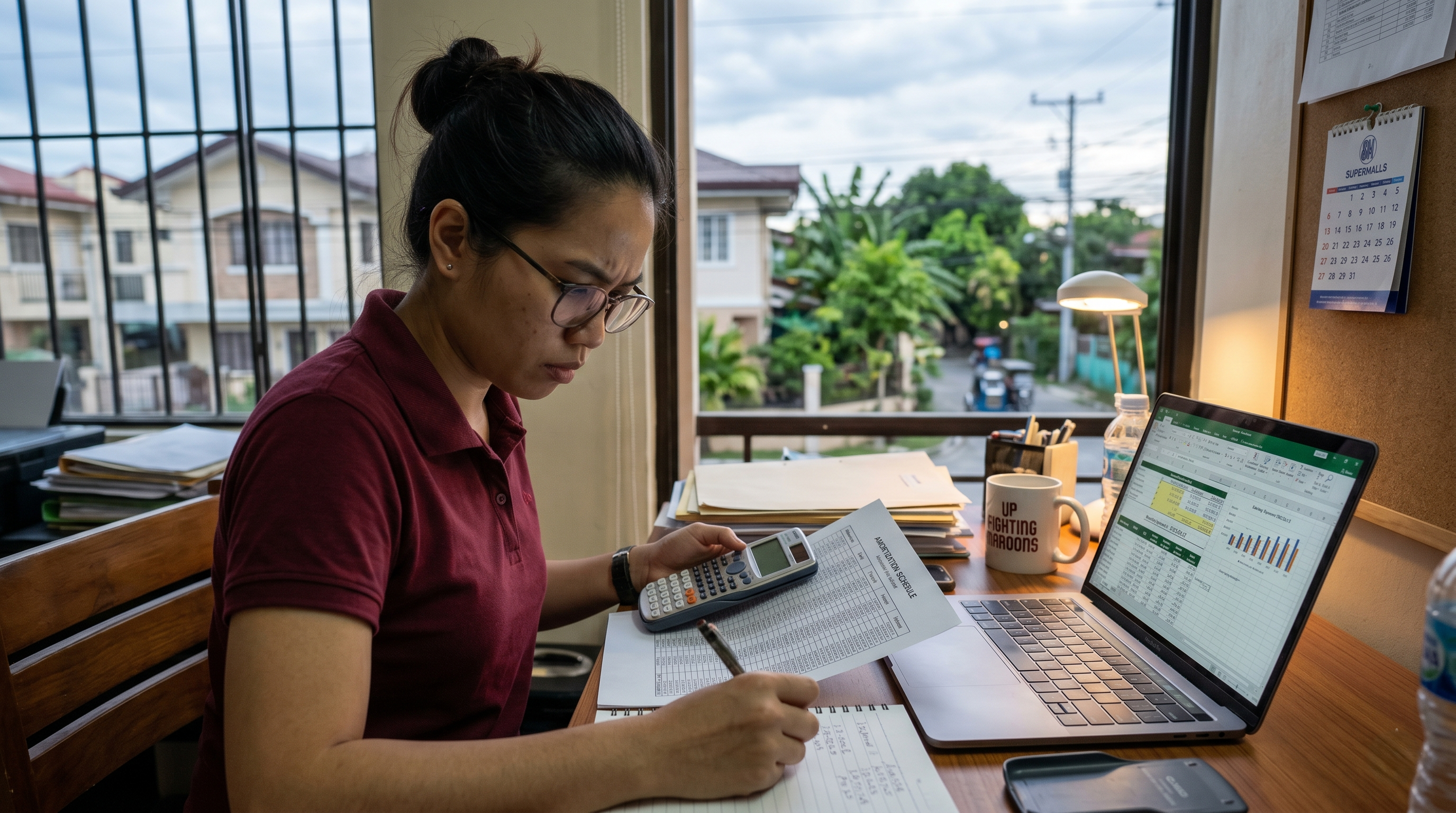
Bank housing loan rates are not fixed for the whole term. A bank fixes your rate for an initial period — commonly 1, 3, 5, or sometimes 10 years — and after that period ends, the rate is repriced to whatever the prevailing market rate is at that time. The longer the fixing period you choose, the higher the initial rate, but the longer you are protected from rate movements.
Why this matters: the low, attractive rate a bank advertises is usually the rate for a short fixing period. Lock in a 1-year fixed rate because it looks cheap, and twelve months later your rate resets to market — which could be higher, sometimes meaningfully so. Your monthly amortization rises with it. Borrowers who budgeted around the introductory rate can get squeezed.
How to protect yourself:
- Match the fixing period to your plan. If you intend to keep the loan for years, a longer fixing period buys predictability even at a higher starting rate.
- Budget for the repriced rate, not the teaser. Stress-test your amortization against a higher rate before committing. If the payment only works at the introductory rate, the loan is too tight.
- Ask about refinancing options. When your fixing period ends, you can sometimes refinance to another bank with better terms — but factor in the costs of doing so.
The honest comparison: Pag-IBIG also reprices after its fixing period — this is not unique to banks. But Pag-IBIG's rates generally start lower. A bank's advantage is rarely price; it is speed, loan size, and qualifying when Pag-IBIG cannot.
When a Bank Loan Beats Pag-IBIG
Pag-IBIG is the default for most buyers because it is cheaper. But a bank loan is the better choice in specific situations:
- You do not have 24 Pag-IBIG contributions. Pag-IBIG requires at least 24 monthly contributions to qualify. If you are short and cannot wait, a bank that does not require fund membership is your route in.
- You earn well and want a larger loan, fast. Banks can lend amounts far above what most buyers need, and high-income professionals often clear bank approval quickly. For a straightforward purchase with strong documents, bank processing can be faster than Pag-IBIG.
- You value speed and have the cash for a bigger down payment. If the 20–30% down payment is not a problem and you want the deal closed quickly, a bank can be more efficient.
- The property or amount falls outside Pag-IBIG's comfort zone. Certain properties or loan structures are easier to finance through a bank.
For the full Pag-IBIG side of this decision — eligibility, rates, and the step-by-step application — see our Pag-IBIG housing loan guide rather than relying on the summary here.
How to Apply for a Bank Housing Loan: The Process
- Step 1 — Pre-qualify. Talk to the bank (or use its online pre-qualification) to confirm your income clears the floor and the DTI math works before you formally apply.
- Step 2 — Submit the application and documents. Income proof, IDs, and the condo's property documents from the developer.
- Step 3 — Appraisal. The bank appraises the unit to set the value it will lend against.
- Step 4 — Credit and background evaluation. The bank checks your credit standing and verifies your income and employment.
- Step 5 — Approval and Letter of Guarantee. On approval, the bank issues terms and, for developer purchases, a Letter of Guarantee to the developer.
- Step 6 — Sign the loan and mortgage documents. Read the fixing period, the repricing terms, and the penalties carefully before signing.
- Step 7 — Loan release and amortization. The bank releases the proceeds to the developer; your monthly payments begin.
The overall purchase sequence — reservation, Contract to Sell, equity, turnover, title — is the same regardless of who finances you. Our step-by-step condo buying process maps where loan application fits into the wider timeline.
Common Mistakes Bank Borrowers Make
- Budgeting around the introductory rate. The teaser rate lapses. Plan for the repriced one.
- Applying with high existing debt. Credit card balances and car loans eat your DTI capacity. Clear them first.
- Forgetting the appraisal gap. If the unit appraises below the price, you cover the difference in cash.
- Self-employed buyers applying too early. Without two to three years of ITRs, expect a harder approval.
- Choosing a co-borrower with weak finances. A co-borrower's debts and credit count against the application too.
- Underestimating closing costs. The down payment is not the whole upfront bill.
Frequently Asked Questions
What is the minimum down payment for a bank housing loan in the Philippines? Banks typically lend around 70–80% of the appraised value, so your down payment is generally 20–30% — larger than the 5–10% Pag-IBIG often requires. The exact figure depends on the bank, your profile, and the appraisal.
Can I get a bank housing loan if I am self-employed? Yes, but the bar is higher. Most banks want two to three years of continuous business operation, supported by ITRs, audited financial statements, and business registration. A younger business faces a harder approval.
Do bank housing loan rates stay fixed for the whole term? No. Banks fix the rate for an initial period — commonly 1, 3, 5, or up to 10 years — then reprice it to the prevailing market rate. Always budget for the repriced rate, not just the introductory one.
Is a bank loan or Pag-IBIG better for a condo? Pag-IBIG is usually cheaper and needs a smaller down payment, making it the default for most buyers. A bank loan wins when you lack 24 Pag-IBIG contributions, want a larger loan, earn well and want speed, or the property falls outside Pag-IBIG's comfort zone. See our Pag-IBIG guide to weigh both.
What disqualifies you from a bank housing loan? The common reasons are a debt-to-income ratio that is too high, poor credit standing or defaults, income below the bank's minimum, insufficient employment or business tenure, and an appraised value that falls short of the loan you need.
The Bottom Line
A bank housing loan is a strong option when Pag-IBIG does not fit — when you lack the contributions, want a larger loan, or value speed and can carry a bigger down payment. The trade-offs are real: stricter income and tenure requirements, a lower loan-to-value ratio, and a rate that reprices once the fixing period ends. Understand those three things and a bank loan is a tool, not a trap.
If you are deciding between a bank loan and Pag-IBIG for a specific condo, our team can walk you through which one your profile and timeline actually favour — no pressure, just a straight answer. You can also test different terms and down payment amounts with our mortgage calculator before you talk to any lender.