
If you're looking at property in Cavite right now, you've probably landed on the same fork in the road: do you buy a condo or a house? Both are available. Both are actively being sold. And the people advising you — agents, developers, family — often have a stake in which one you choose.
This article isn't going to tell you one is objectively better than the other. It's going to show you how they actually compare in Cavite specifically — where the trade-offs are real, what each option costs you in ways beyond the purchase price, and which type of buyer typically makes the right call with each one.
The Core Difference: What You're Actually Buying
A house in Cavite typically means a single-family home inside a subdivision — two to three bedrooms, a small private yard or garage, and a title that covers both the structure and the land beneath it. You own the lot. What you build or modify on it is, within the subdivision's rules, yours to decide.
A condo means a unit inside a shared building. You own the airspace your unit occupies — the interior — and you hold a share in the common areas. You don't own the land. The building is governed by a condominium corporation with its own rules about what you can do with your unit, who can visit, and how you can use shared amenities.
That distinction — land ownership versus unit ownership — is the root of almost every practical difference between the two.
What Each Option Realistically Costs in Cavite
Without getting into specific figures, here's the general landscape in Cavite as of 2026.
Entry-level houses (socialized and economic housing)
Cavite has an abundance of low-cost socialized and economic housing projects — small row houses and single-attached units with floor areas typically between 22 and 42 sqm on a lot of 36 to 60 sqm. These represent some of the most affordable entry points in Philippine residential real estate. The trade-off is size, finish quality, and location — many of these developments sit further from established commercial and transport hubs.
Mid-range houses
Step up to a decent single-family home in an established Cavite subdivision — 3 bedrooms, covered parking, a proper lot — and you're in a significantly higher price bracket. Quality, lot size, and community infrastructure vary widely at this level. Some subdivisions are genuinely well-managed; others are not.
Condos in Cavite
Mid-rise condos in Cavite, particularly in the Imus and Bacoor corridors, offer a range of entry points from studio units up to two-bedroom configurations. The price per square meter in Cavite is substantially lower than Metro Manila equivalents — a studio unit that would cost you several million pesos more in BGC or Makati is accessible in Cavite at a fraction of that price.
The honest comparison: for a similar outlay, Cavite condos often give you more modern amenities and a better-managed environment than a same-budget house, while houses offer more private space and land. The right comparison depends on what you actually need.
Key point: In Cavite, the condo vs house decision is rarely about which is cheaper. It's about what your money gets you — and which trade-offs you're willing to make over a 10 to 20-year horizon.
Space: More Complex Than Square Meters Suggest
A house wins on absolute space — a 60 sqm house is meaningfully larger than a 21 sqm condo studio. But the space comparison is more nuanced than raw floor area.
A well-designed condo in Cavite, particularly one that includes a loft level or elevated mezzanine, can use vertical space efficiently in ways that make a smaller floor plate feel larger than the number suggests. Shared amenities — a resort-style pool, landscaped parks, function halls — extend usable living space beyond the unit itself. If you're buying a house in an entry-level subdivision, the lot may be small, the layout fixed, and the shared infrastructure minimal.
For families with young children, houses generally win on practical livability: a yard, a garage, dedicated bedrooms with privacy, space for storage. For singles, couples, or young professionals, a well-appointed condo often provides more than enough living space with amenities the house equivalent at the same price simply can't offer.
Maintenance: Where Houses Quietly Bite You
This is the cost that most house-versus-condo comparisons underemphasize.
When you own a house, you own the problems too. The roof, the plumbing, the perimeter wall, the garden — all of it is yours to maintain, fund, and coordinate. In the Philippines, where weather events are frequent and deferred maintenance compounds quickly, the ongoing cost of keeping a house in good condition adds up. These costs are variable and hard to budget for.
A condo shifts most of that to the condominium corporation. Your monthly association dues cover building maintenance, security, amenity upkeep, and common area repairs. You don't get a surprise roof bill. The predictability of a fixed monthly due — versus the unpredictability of house repairs — is a genuine advantage for buyers on a tight monthly cash flow.
The downside is that you pay dues whether you're in the unit or not, whether the amenities are being used or sitting empty. And if the condo corporation is poorly managed, dues can rise with nothing to show for it. Before buying any condo, check who manages the building, how long they've been doing it, and what the current due structure looks like relative to what's actually being maintained.

Appreciation: Which Holds Its Value Better?
This is where the Cavite context matters most — and where the answer differs from Metro Manila.
In established Metro Manila locations, houses (particularly those with land in desirable areas) have historically appreciated more reliably than condos, because land in those markets is genuinely scarce. The land component of a house title is what drives long-term value.
In Cavite, the calculus is different for two reasons.
First, land in Cavite is still relatively abundant compared to the inner Metro. The premium that land commands in Makati or BGC simply doesn't apply in the same way in Imus or Bacoor. A house's lot in an outer Cavite subdivision doesn't appreciate at the same rate as a house lot in an established urban village.
Second, condos in well-located, well-developed master-planned communities in Cavite are benefiting from infrastructure investment — the CAVITEX, the CALAX, the planned LRT-1 Cavite Extension (projected to reach Bacoor by 2031) — in a way that raises property values across the entire corridor. A condo inside an established masterplan with built-in demand drivers (schools, commercial areas, transport links) can appreciate meaningfully as the corridor matures.
The key variable isn't condo versus house — it's location within Cavite, the quality of the development, and the surrounding infrastructure. A house in a poorly located Cavite subdivision will not outperform a well-located condo. The inverse is also true. For a fuller look at the infrastructure driving Cavite's appreciation story, see our guide on why Cavite is a strong investment in 2026.
Flexibility: Renting, Reselling, and Changing Plans
Investors often think about this more carefully than end-users — but it matters for everyone.
Rental potential
Condos generally rent more easily than houses in the Cavite market. The tenant profile for condo rentals — single professionals, young couples, employees of nearby commercial zones — is large and growing. A furnished studio or one-bedroom in a well-managed condo with good amenities can attract consistent tenants. Houses rent well too, but the tenant pool skews toward families, which means longer tenancies but also more selectivity and higher vacancy risk between leases.
Short-term rentals (Airbnb-style) are also more naturally suited to condos than houses — although this depends entirely on what the condo corporation allows. Always check the building's house rules before counting on short-term rental income as part of your return. Our condo ROI and Airbnb guide covers this in detail.
Resale
Houses with land titles tend to resell more cleanly in the Philippines — there is no condominium corporation involved, no certificate of title restrictions tied to a shared structure, and the transaction is simpler. Condos can be more complex to resell: you're selling a unit inside a building, the building's condition matters as much as your unit's condition, and buyer financing for condos has more variables than for a house-and-lot.
That said, a well-maintained condo in a desirable building will always find buyers. The challenge is a neglected condo in a poorly managed building — one that is very difficult to recover value from even with improvements to the unit itself.
Community and Security
Condos offer built-in community and security infrastructure that most Cavite subdivisions cannot match at the same price. A mid-rise condo in Cavite typically comes with 24/7 security personnel, CCTV coverage, controlled building access, and proximity to neighbors that creates informal surveillance. For OFW families leaving a unit unoccupied for months at a time, this is a meaningful advantage.
Houses in gated subdivisions also offer security — guard posts, perimeter walls, limited access — but the per-unit cost of that security is typically lower than a condo's, and the amenity infrastructure (pools, function halls, gyms) is often less comprehensive unless you're in a higher-end subdivision.

Who Each Option Suits Best
Condos tend to suit:
- OFWs who want a low-maintenance asset that earns rental income and requires minimal management from abroad. The security, the association-managed upkeep, and the easier rental profile all reduce the burden of remote ownership. See our OFW real estate guide for the full process.
- First-time buyers with a limited initial budget who want modern amenities and a well-managed environment without taking on a full house's maintenance burden from day one.
- Investors who are buying for rental income and appreciation rather than personal occupancy, particularly if they won't be on-site to manage a property.
- Young professionals and couples without children, for whom private yard space is less important than location quality, amenities, and lifestyle convenience.
Houses tend to suit:
- Families with children who genuinely need more private space — dedicated bedrooms, a yard, a garage — and who plan to occupy the property for the long term.
- Buyers who prioritize land ownership and the flexibility to modify, extend, or eventually redevelop their property without the constraints of a condominium corporation.
- Long-term Cavite residents who are already embedded in a specific barangay or municipality and want a home that's genuinely rooted in that community rather than a managed residential complex.
- Buyers who find monthly association dues unappealing — the ongoing cost of condo dues is a real factor, and for buyers who won't use the amenities heavily, it can feel like money without return.
The honest summary: Neither a condo nor a house is universally better in Cavite. The right answer depends on how you plan to use the property, how long you plan to hold it, and how much maintenance involvement you're willing to take on. Match the product to your actual lifestyle and investment goals — not to what someone is trying to sell you.
The Cavite-Specific Factor That Changes Everything
One thing distinguishes the Cavite condo market from what you might expect if your only reference is Metro Manila: the master-planned community model.
In BGC or Makati, a condo is often a standalone tower embedded in an urban environment where all the surrounding infrastructure already exists. The condo delivers vertical density; the city delivers everything else.
In Cavite, the best condo developments are built inside large master-planned communities — self-contained zones with their own schools, commercial strips, churches, parks, and transit links. Buying a condo in a development like Lancaster New City means buying into an established community ecosystem, not just a building. That community-level infrastructure is what creates the rental demand, the day-to-day livability, and the appreciation potential that makes a Cavite condo a genuine alternative to a standalone house.
A condo in a random location in Cavite — isolated from transport, services, and community — is a different product entirely. The question isn't just condo or house: it's which specific development you're evaluating and what surrounds it.
Where One Lancaster Park Fits This Comparison
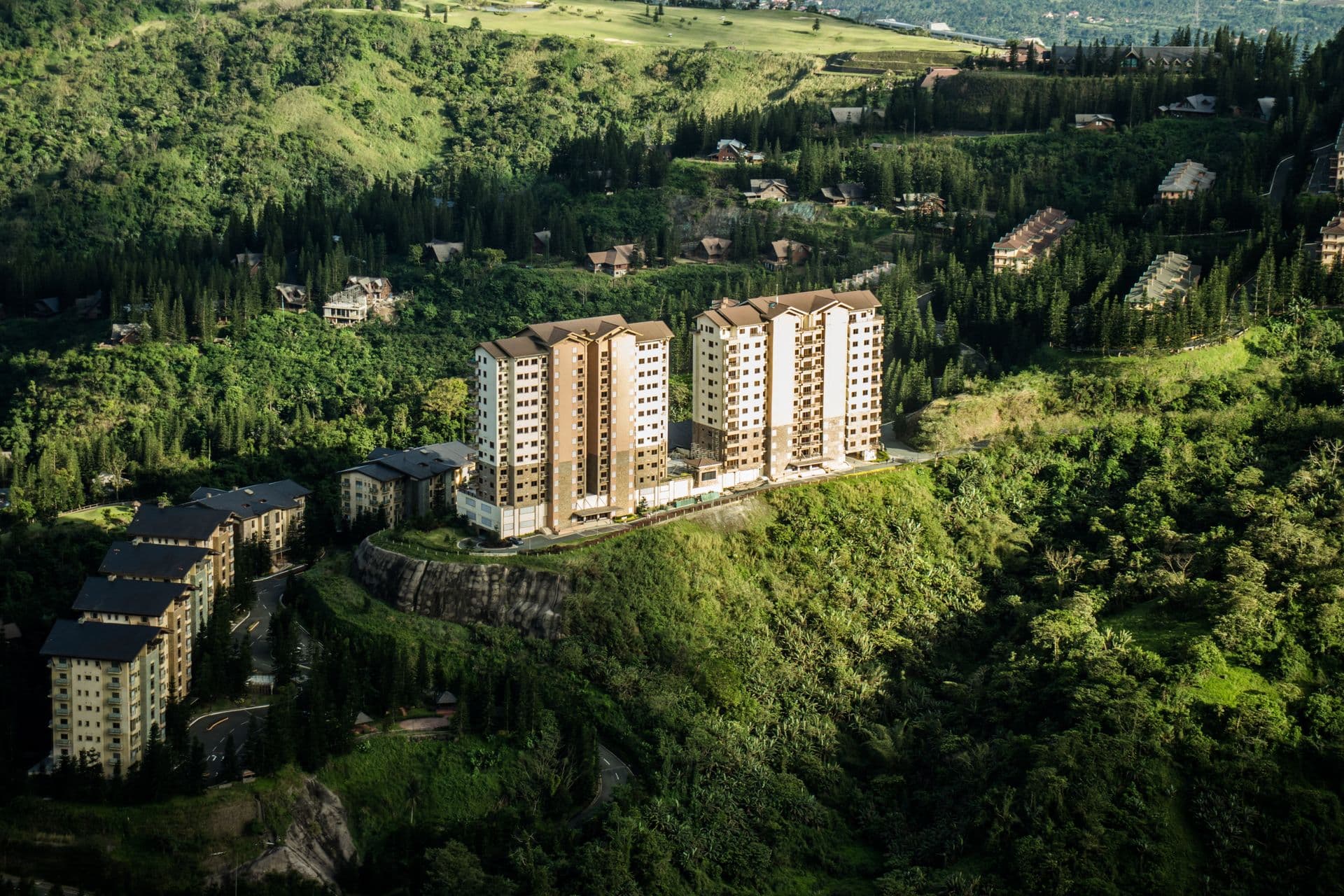
One Lancaster Park is a mid-rise garden condo inside Lancaster New City in Imus — one of the largest master-planned communities in the Philippines. If you're weighing condo options in Cavite specifically, it's a reasonable benchmark for what a well-positioned Cavite condo actually looks like.
It's developed by PH1 World Developers, engineered by Megawide Construction Corp. (publicly listed, with a portfolio that includes the Mactan-Cebu International Airport redevelopment), and carries DHSUD License R4A-070124-0279. It won Open Space Development of the Year — Philippines at the Real Estate Asia Awards 2024 in Singapore. The project dedicates 70% of its 10-hectare site to parks, walkways, and open areas — a design philosophy that directly addresses one of the main objections to condo living: that it feels cramped and disconnected from nature.
It's preselling, with Tower 3 completing in 2028. That means buyers are committing to a wait — something the pre-selling guide covers honestly, including the risks and how to evaluate whether a preselling project is worth committing to.
If a house in Cavite better fits your needs — you have three kids, you need a garage, you want a yard — that's the right call. This project isn't for every buyer. But if you're evaluating condos in Cavite and want to see what a well-credentialed option inside an established masterplan looks like, our team can walk you through the specifics.
Frequently Asked Questions
Is it better to buy a condo or a house in the Philippines as a first property?
It depends on your situation. Condos tend to have lower entry points, require less maintenance, and offer modern amenities — which suits first-time buyers with a limited budget and no plans for a large family in the near term. Houses offer more space and land ownership but come with higher upfront costs at comparable quality levels and ongoing maintenance responsibility. Neither is automatically the better first property; the right answer depends on your income, lifestyle, and long-term plans.
Do condos appreciate faster than houses in Cavite?
Not necessarily faster — but condos inside well-located master-planned communities in Cavite's growth corridors have appreciated meaningfully as infrastructure improved. Houses appreciate too, but their rate depends heavily on land scarcity and location. In outer Cavite, land is less scarce than in Metro Manila, which limits the land-driven appreciation premium that houses enjoy in established urban markets.
Can OFWs buy a house in the Philippines the same way they buy a condo?
Broadly yes — the Special Power of Attorney process and financing options apply to both. The practical difference is that condo purchases tend to involve more standardized developer processes that are easier to handle remotely, while house purchases may involve more site visits, contractor coordination, and local presence for punch-list and snagging. For OFW buyers specifically, condos often present a lower-friction remote purchase. See our OFW real estate guide for the full process.
What financing options are available for condos in Cavite?
The main options are Pag-IBIG housing loans, bank loans, and developer in-house financing. Pag-IBIG is typically the most affordable for eligible members, with rates starting at 5.75% p.a. and terms up to 30 years. The Pag-IBIG condo financing guide covers eligibility, required documents, and the step-by-step application process. The same financing options generally apply to houses as well.
Is a condo a good investment in Cavite if I'm not going to live in it?
It can be, if you choose the right location and building. The strongest investment case for a Cavite condo is one in an established master-planned community with built-in demand drivers — employment, schools, transport access — that supports consistent long-term rental demand. That rental income, combined with appreciation in a developing corridor, is what makes the investment case. A condo in a poorly located or poorly managed building is a weaker bet regardless of the headline price.